Distinguished from natural sciences that explore the natural patterns and laws of the material world, the humanities are academic disciplines that focus on human beings and our accumulating human legacies across generations, such as studies of philosophy, languages, literature, history, religion, emotions and politics. The humanities delve into our past and present, our ideologies, our ways of expression, our wisdom, etc., to understand what it is to be human beings, and how we have come to be similar and different. Since the humanities promote empathy and understanding between different human cultures, there are no definitive answers to most questions, and every scholar can have a different version of understanding based on their personal contexts.
The Humanities is a course with ambitions to fulfill the interdisciplinary aspirations shared—no single subject but rather the interaction of many could better answer the questions of humanity. It is why, so far, we have had lectures on history, Latin American studies, philosophy, theatre performance, German studies, photography, race and gender, emotions, religion, social activism, and pleasure, led by faculty and visiting professors with different academic expertise. In the following paragraphs I will explain the focuses of the Humanities course to explain the discipline’s diversity and versatility.
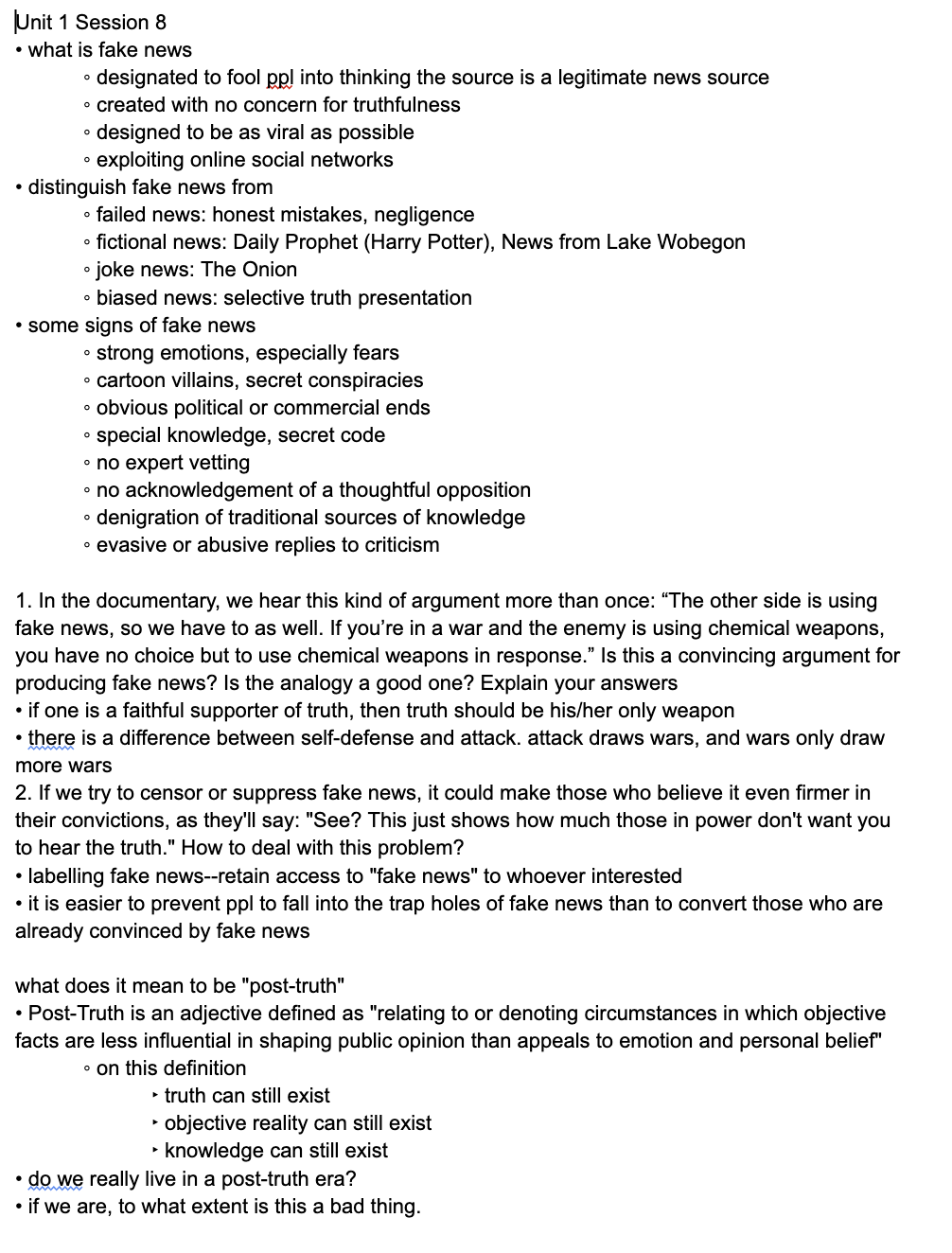
In the first unit of philosophy led by Dr. Robb, we dug into truth, knowledge, conceptual schemes, idealism, translation, and fake news. For instance, we discussed rationalism and empiricism as two approaches to qualify certain beliefs as knowledge. We also examined fake news, including the objectives of misinformation, the power of the provocative language, and the audience’s vulnerability. Meanwhile, inspired by Dr. Robb’s unit, in my paper On Liberty: On Objection, I explored John Stuart Mill’s On Liberty‘s implications for our modern world of fake news by reconsidering its ground on free speech, and the significance of argumentation and objection in a modern context.
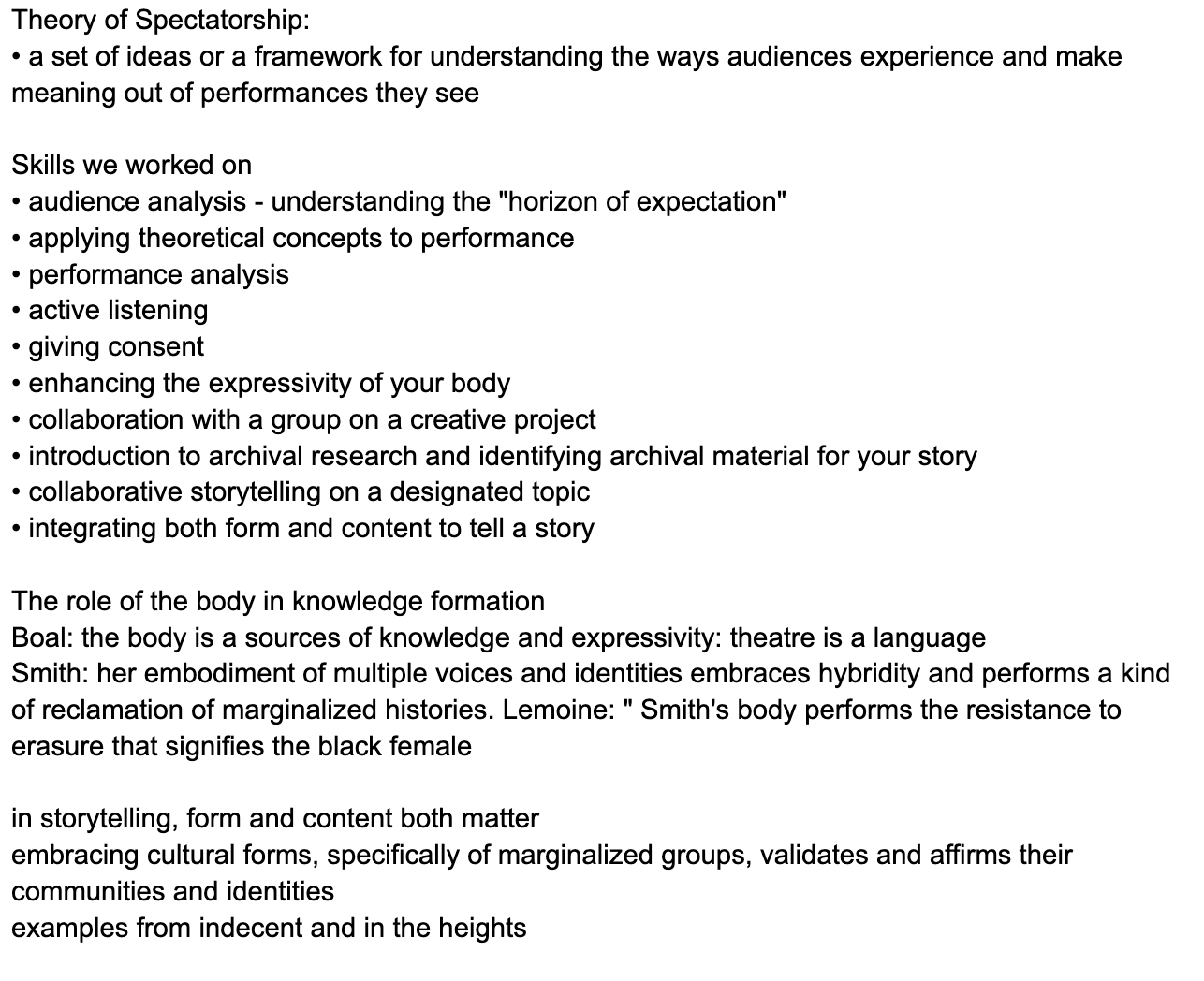
In the second unit of theatre performance led by Dr. Greene, we learned theories of spectatorship, watched a musical On the Heights and a monologue Fires in the Mirror, and performed our own plays. It was a reflection on what, how, and why we spectate. It was also a novel experience for me to shift my role as an audience to a creator to create a script, direct a play, and act in a real performance.
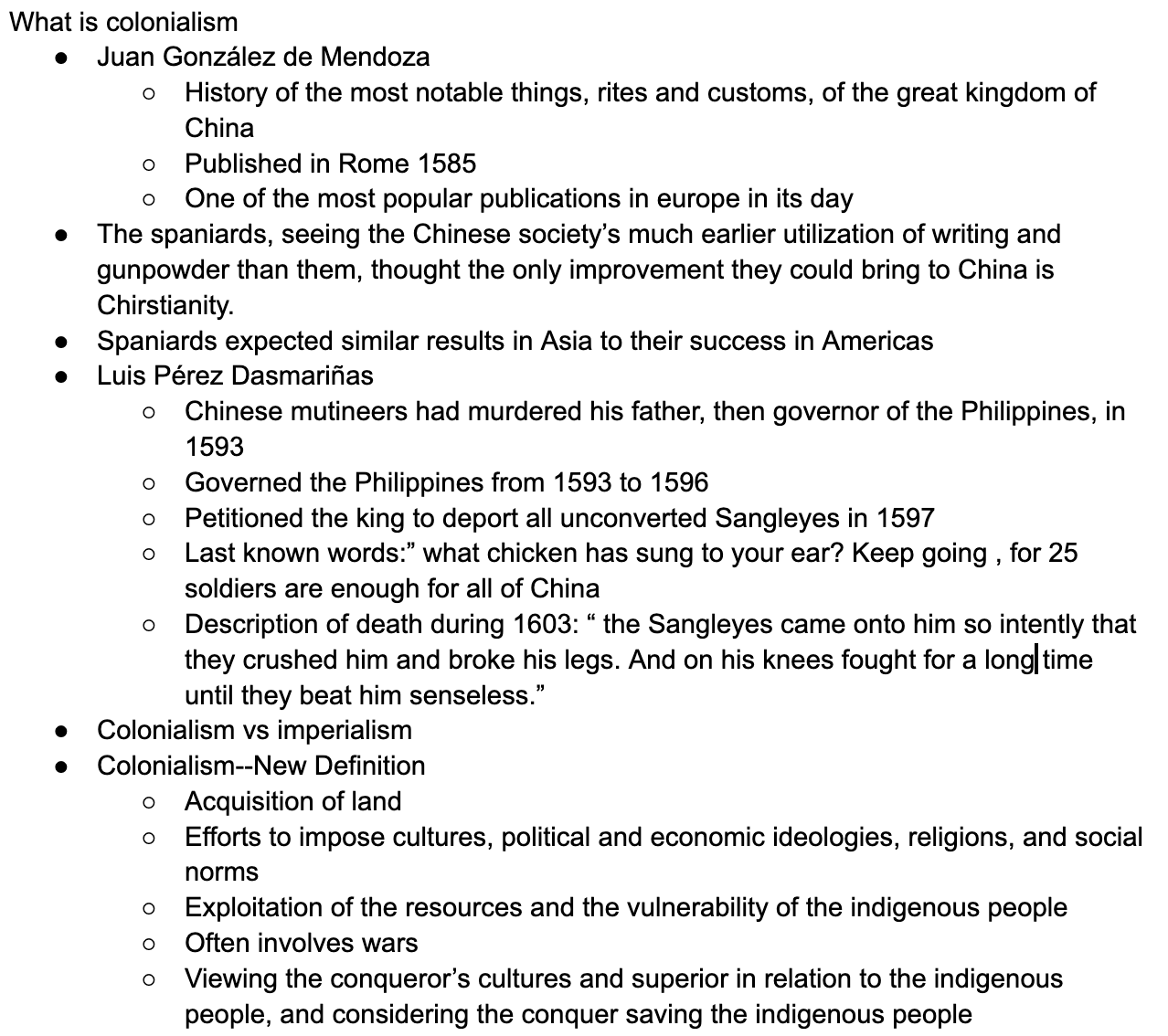
In the last unit of history led by Dr. Luis, we focused on a case study of Spanish settlement in Manila and local Sangleys, discussing the miscegenation, cultural diffusion, and conflicts resulting from different populations’ encounters. In my paper for the unit, “Race and Racial Identity in Colonial Latin America,” I explored for the very first time the complexity, fluidity, and socio-economic nature of the concept of race in the context of an historical area where large-scale miscegenation took place. Specifically, I was introduced to how race is not just categorization, but also a tool of oppression yet as well as a tool for anti-oppression as people manipulate/redefine their races through different means.
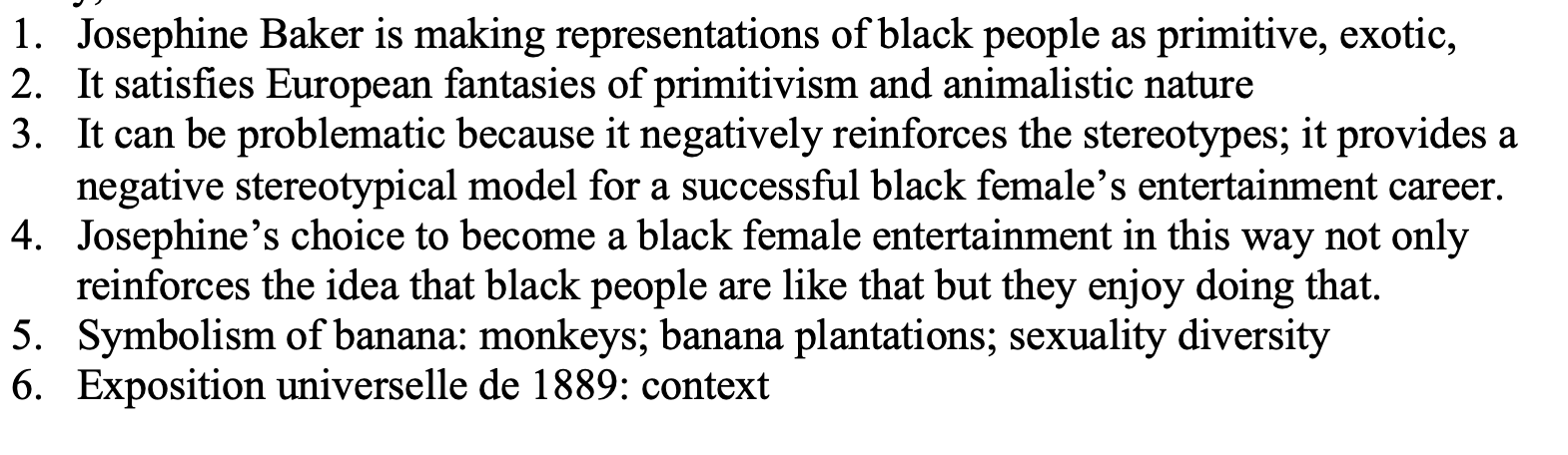
In unit 4, we had deeper conversations of oppression through the case studies of Sarah Baartman and Josephine Baker in the context of racism, white gaze, and the fetish for black exoticism and erotism in the United States. And we delved into how the body of Sarah Baartman was controlled, manipulated and capitalized on to cater to to the western world’s curiosity about exotic black female bodies. Decades later, in opposition to Sarah Baartman, Josephine Baker ironically took advantage of her black body and foreign citizenship to come to fame in the United States as a performer. The unit led us to ponder upon the origins of the racial power hierarchy as well as patriarchy.
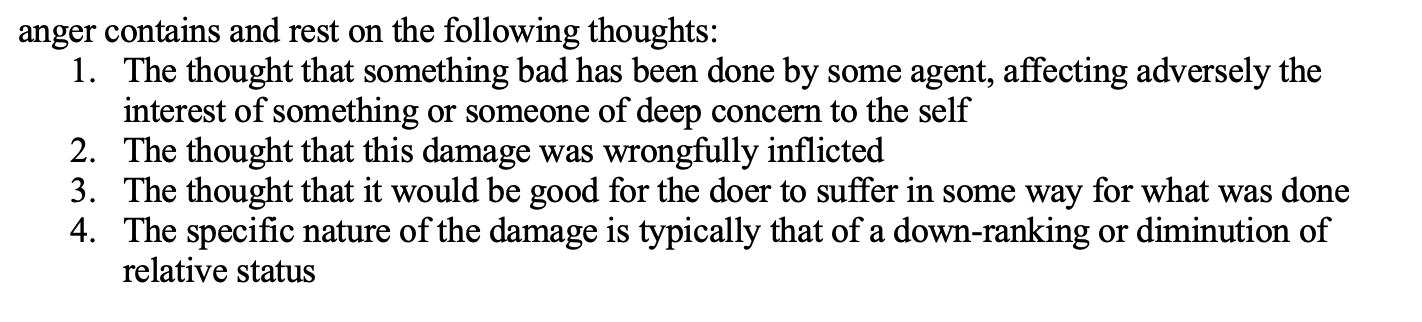
In unit 5, we discussed about emotions. What are the sources of emotions? Are emotions physical or mental? What are the categories of emotions and how do different types interact? What are angers and their sources? Are angers justified? What is virtue and how to be virtuous?
In unit 6 & 7, we focused on how body / bodies is/are a tool of self-expression (e.g., sexuality and social activism) and a source of both pleasure and pain through case studies of the HIV pandemic in NYC and gay rights activism and exploration of love, pleasure and religious interpretation of ecstasy.
The topics we have studied over the year, theatre, religion, truth, history, arts, race, human rights, activism, emotions, and pleasure, are all elements that constitute the study of humanities, and ther are the perfect illustrations of the nature of this course, inclusiveness and diversity.
For the collaborative project, we conducted interviews with interviewees ranging from a former Humes professor, a coffee shop worker, a current Humesters, a non-Humesters, and an art history professor. For this part of my answer to the definition of humanities, I will share their answers to the question and my thoughts on them.
Generally, it turned out that the definition of humanities is a question that not everyone can readily have a clear picture of, and most of the answers converged on one vague point: the humanities is ultimately a study of anything human, such as what it is like to be human, distinct from being animals, and the products of human (cultural and social). It is also regarded as one’s understanding that could evolve as time passes. Since it is a subject focused on humans, who are unique and fluid individuals that can’t be easily generalized or defined, humanities are then by definition not as testable as sciences, which could be theorized, tested, generalized, and predicted.
It also leads to an interesting thought: what if it is never appropriate to try to define specifically what humanities are? Since humanities are relational and fluid, referring to definitions by preceding scholars or trying to provide a clear definition for our successors might only be outdated and misleading. Is it better to keep it just as a vague sentence, “anything related to humans”?
Acknowledgments
This essay is built partially on Dr. Robb’s “On Definitions.” https://hum.davidson.edu/resources/on-definitions-by-prof-robb/
I also consulted lectures and notes from units 1-7.