What does “body” mean? Before digging into its definition, we need to figure out which definition we need for “body.” Dr. Robb observes in “On Definition” that there exist two general kinds of definitions: 1) descriptive definitions that “define a term (or concept) as it’s currently used” 2) prescriptive definition that “say how a term should be used, whether or not this matches current usage.” For a prescriptive definition, Dr. Robb specifies that it should be guided by social and ethical principles and epistemic principles. That is, a prescriptive definition must be based on social and ethical integrity/righteousness and correctly corresponds to existing human knowledge.
From my perspective, it is proper to aim for a descriptive definition for “body.” “Body” is an abstract term with incredible versatility that fits into all kinds of conversations (e.g., “your body is in shape”; a body of water, the body paragraph, a dead body, etc.). Meanwhile, there are barely any challenges against the existing meanings of “body.” It also seems unlikely that scholars would engage in scholarly debates on how “body” should be defined in an ethically and epistemically correct way as they do with humanities. For now, I would provide my partial collection of the descriptive definitions of “body” while I relate it to different disciplines in this essay.
“Body” is an extraordinarily complicated, biologically functioning structure that serves as a vessel for the human mind which is an existence that presumably lacks a physical representation. In this case, the brain is the master of the whole body, receiving and firing of neurons to create automatic functions, cognitive activities, memories, etc. The rest of the body helps perceive and translate sensations (touch, sight, hearing, smell, and taste) into neural messages and transmit them to the brain, meanwhile capable of physically moving under the brain’s instructions. Basically, with a body, we can have mind. With mind, we can recognize that we have a body.
“Body” is also the constraint of mind because the nature of a body usually determines what mind could perceive. A body is like Plato’s Cave, and mind is like Plato’s prisoners. What knowledge mind could harvest depends on what a body allows it to explore. For instance, with the common assumption that the human physical structure is our body, its three-dimensional nature limits the mind’s perception and understanding of the world to three-dimensional phenomena.
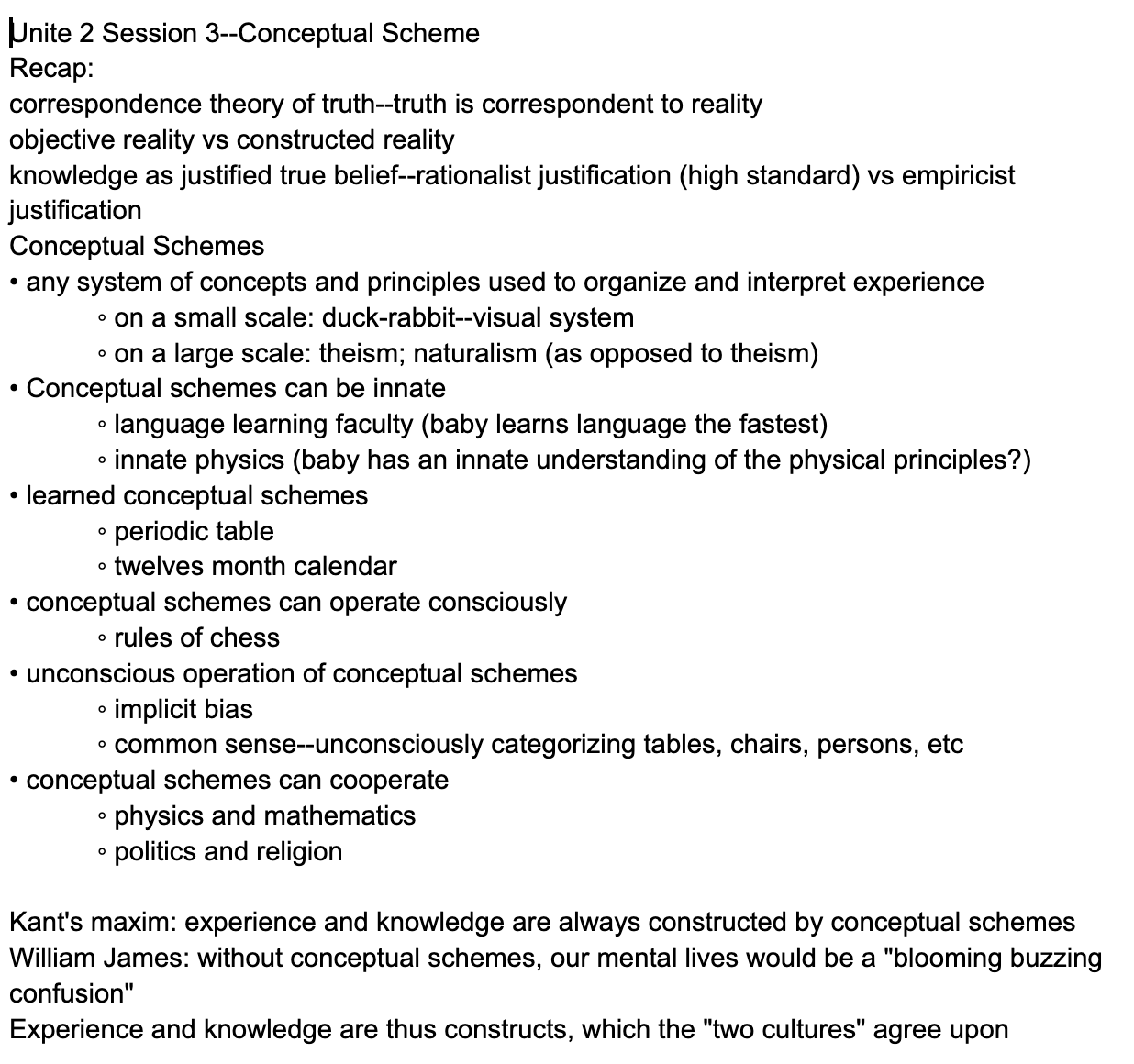
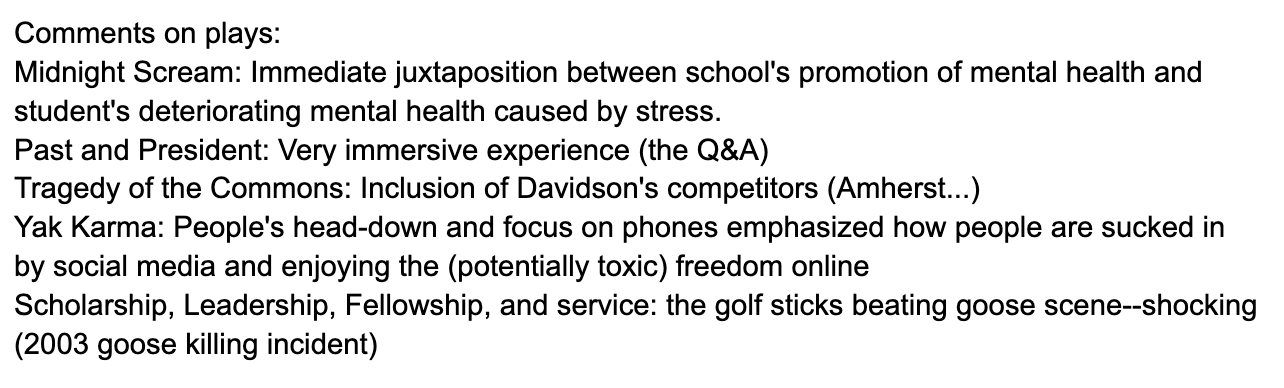
In still art and moving theatre performance, “body” embodies stories and minds. One of the most common forms of still art is sculpture, which depicts bodies of different forms and gestures, from which the audience can infer the context of the depiction, the event taking place, and the emotions of the characters. For instance, Donatello’s David depicts the scene where young David, nude except for his helmet and boots, stands casually and confidently with his left foot on Goliath’s beheaded head. It leads the audience to imagine the story where an untrained young biblical hero bravely fights and kills an evil figure and celebrates his victory with pride. In theatre performance, body is a more vivid and detailed embodiment of stories and minds. For instance, one of our theatre unit performances used bodily representations such as a performer crawling to mimic a goose, a man swinging golf clubs at the goose, and a crowd of spectators smiling and chatting. These bodily movements represent a story where a frat boy is physically abusing a goose while other students are spectating the incident with enjoyment.
While our mind is the writer, “body” is the pen of history. Without a bodily embodiment, our mind is isolated from realities, unable to physically change the world. Humanity has proved the significance of a body by using it to construct complicated tools and machines, explore extraterrestrial space, and invent life-saving medicines. Only with bodies could the Spanish colonizers settle in Manila and commit the massacre of the Sangleys. Only with bodies could the Renaissance and Enlightenment ideas spread to the peripheral world. In simple terms, “body” enables everything manmade.
However, there are challenges against what we now normally perceive as a “body.” Some scholars argue that the body as a biological structure could be an illusion created by a system that we could not yet perceive or understand. For instance, it could be a system of codes run by computers that makes us falsely perceive and believe that the biological structure is our body but in fact the computational system is the real body. If this assumption is true, we need to simplify the definition of “body” to a carrier of any form that allows the human mind to exist.
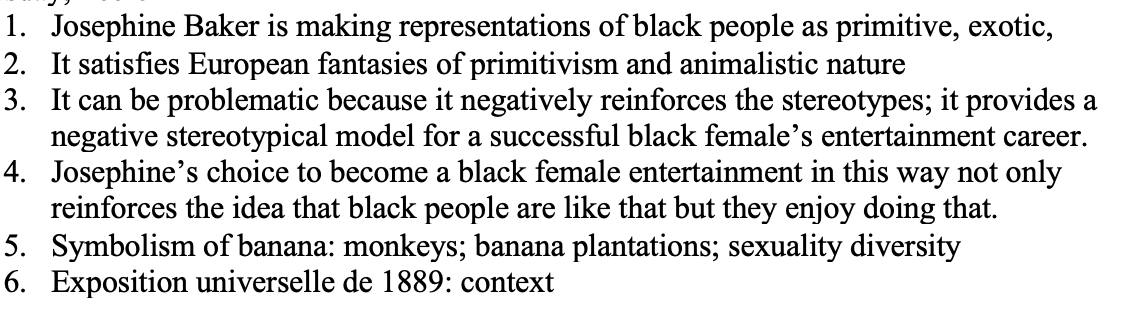
Body could also be a means of oppression. Throughout the history, people have been comparing and ranking their bodies against others. Those with darker skin tone were enslaved. Those with “heretic” faith were excommunicated and ousted. Those with “inferior” bloodline were slaughtered. Those who identify or love differently were spitted at. There might be no better example than the “Hottentot Venus” that we studied in Unit 4, whose body was controlled, displayed, eroticized, disdained, abused, scrutinized, peeped at and capitalized on. Josephine, as the successor of the “Hottentot Venus,” voluntarily used her body to cater to the western world’s exotic and erotic black body fetish. Even though her act granted her an incredible career and fame, it however consolidated the exploitation of bodies different than the “mainstream.”
For my collaborative project, I asked people about bodies. Most of the answers from our interviews converged on that body is the material part of our being, as I have tried to explain in my previous definition. However, one point that Professor Corso-Esquivel brought up intrigued me. “When we go to, say, a concert, and we start dancing all night without necessarily talking, we have our experience of the body without the definition. It’s a kind of live experience.” It makes me relate to experiences like how we always forget about breathing until we have trouble breathing. It is always when we are having intense sensual and emotional input (e.g., feeling sick, getting drunk, feeling exhausted from tennis, dancing in a concert, or going through emotional struggles and heartbreaks like in In the Mood for Love) that our body is accentuated and that we can actually experience it. In those instances, we can feel that the experience, including the immediate surrounding (e.g., the intense sun, the wind, the noises, and even the quietness), are inherently part of our body. Live experience makes up a part of our body, and such experience is by definition interconnected with our environment. It is also interesting because, the talented New Zealand singer also shared during her concert in Nashville, “I feel like I have been writing about bodies,” as a compilation of experiences and emotions and not just out physical being.
In unit 6 & 7 , we have also discussed how body can also be sexuality, pain, self-expressions, weapons and pleasure. In the films Paris is burning and 5B, I witnessed how bodies are used by the queer community to find comfort, acceptance, expressions, and self-affirmations. The drag show is a way to do it. Their bodies wear clothes that are assigned to the opposite of their biological gender, they act as if they were in the bodies of their opposite sex, and they use their body in their queer community to find comfort that is no where to be found in the cold real world. In the film 5B, bodies were pleasure but also pain. Bodies enliven queer love through pleasure, yet bringing upon the queer community horrible mental and physical suffering of the HIV pandemic. Bodies were the vessel of desperation.
Acknowledgments
This essay is built partially on Dr. Robb’s “On Definitions.” https://hum.davidson.edu/resources/on-definitions-by-prof-robb/
I also consulted lectures and notes from units 1-7.
